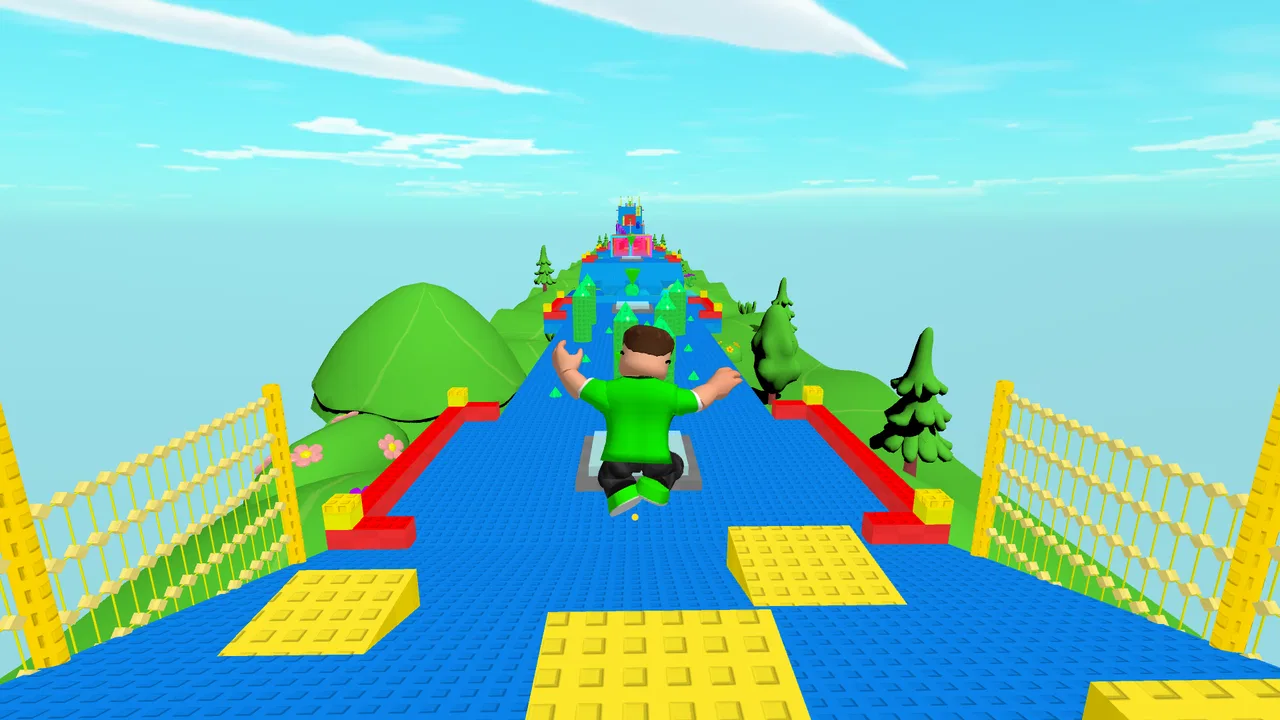
Obby's World Easy Parkour
- 3.3
- Rating
- 5.00M
- Installs
- Free
- Price

 Analysis by App-foxy
I started Obby's World Easy Parkour expecting a light obstacle-course game, the kind of thing I could open for a few minutes and close without much commitment. That first impression is mostly right, but the game has a more appealing rhythm than its simple presentation suggests. You move through parkour challenges, react to what is directly in front of you, fail when a jump goes wrong, and immediately feel the pull to try the same section again with a slightly better approach. It is not trying to replace a large adventure game. Its appeal is the small, repeatable satisfaction of turning an awkward jump into a clean run.
This is a free adventure game from H2T GLOBAL PTE. LTD., aimed at Everyone and available for devices running Android 7.0 or later. The game reached the store on April 16, 2025, and its current version is 1.19. With over 5 million installs, it has clearly found an audience among players who enjoy short, accessible obstacle challenges, although its average rating of 3.5 from around 3.3 thousand ratings suggests that the experience will not suit every player equally.
From the first jump to the first restart
The first action is deliberately easy to understand: move forward, read the next obstacle, and commit to a jump. There is no complicated setup to learn before the game becomes playable. That matters because parkour games live or die by how quickly they get out of the way and let the player test movement. Here, the central question arrives almost immediately: can I judge the distance, choose the right moment, and land without losing momentum?
You May Also Like

 Blood Strike: 2.5 Anniversary
Blood Strike’s Loadouts Turn Every Drop Into a Tactical Gamble
A close look at Blood Strike’s custom loadouts: how fast access to signature weapons reshapes its battle royale rhythm, rewards preparation, and narrows the gap between fights.

 Pandora - Music & Podcasts
Pandora’s Music Is Easy to Start, but Harder to Recover
Pandora’s strength is its low-effort path from a seed to a station. Its weak spot is how much confidence it asks you to place in connection, setup, and quiet recovery.

 8 Ball Pool
 Is Built on Rivalries, Rematches, and Routine
A close look at the rivalries, rematches, shared routines, and unanswered safety questions that turn a quick pool match into a persistent mobile community.

 Samsung Music
’s Quiet Strength Is Playing What You Already Own
Its reach comes less from spectacle than from dependable access to a personal library. That simplicity is both the app’s strongest retention engine and its ceiling.

 AccuWeather: Weather Radar
AccuWeather Review: A Quick, Clear Forecast for Everyday Decisions
For everyday plans, the best forecast is the one you can understand quickly. AccuWeather makes rain timing, radar, and local conditions easy to act on, with a few trade-offs.

 Hill Climb Racing
Why Hill Climb Racing Still Turns Crashes Into One More Run
A tiny car, a bumpy hill and one more upgrade: Hill Climb Racing keeps resurfacing because its simple chaos makes every near-miss feel personal.
More From Our News Desk



I like that the game makes each obstacle feel like a small decision rather than one huge puzzle. A platform may look reachable, but the successful attempt depends on starting the jump from a sensible position and not rushing the input. When I failed, the mistake was usually easy to understand. I had jumped too early, approached at a poor angle, or treated a narrow landing as if it were a wide one. That clarity is important for younger players and for anyone who wants a casual game rather than a demanding technical challenge.
The word “easy” in the title sets a useful expectation, but it should not be mistaken for “effortless.” The opening experience is approachable, yet timing still matters. Players who dislike repeating a jump may find even a forgiving obstacle course irritating. On the other hand, the accessible design gives beginners a fair chance to understand how the game wants them to move before frustration takes over.
For a realistic everyday use case, I can see myself opening it while waiting for a bus or taking a short break between tasks. One attempt can be brief, and a failed run does not require a long recovery period. I do not need to remember a complicated plot, manage a large inventory, or rebuild a character before playing again. I simply return to the obstacle in front of me and try to handle it more cleanly.
The controls are also where expectations need to stay realistic. A parkour game depends heavily on movement precision, and a touch screen is not always the ideal place for that. If your phone has a small display or your hands tend to cover the action, judging landings can become harder than the obstacle itself. I would recommend playing with the screen unobstructed and keeping inputs deliberate rather than tapping repeatedly in panic.
Why the movement feedback keeps me trying
The strongest part of the experience is the feedback rhythm. I make an input, see the character move, discover whether the timing worked, and receive an immediate answer. That short chain is the reason the game can hold attention without needing a complex story. A successful landing gives a modest burst of confidence, while a miss points directly toward the next adjustment.
That rhythm works best when I treat every attempt as information. Instead of asking only whether I won or lost, I look at where the jump began to go wrong. Did I leave the platform too soon? Did I approach the edge too quickly? Did I fail because I was trying to move while also deciding where to land? This approach turns repetition into practice rather than random retrying.
One useful habit is to pause mentally before each difficult gap, even if the game itself does not ask me to stop. I watch the route, identify the landing area, and then make one committed movement. This is more reliable than constantly correcting direction during the jump. On a touch device, overcorrecting can be especially costly because a small extra movement may turn a nearly successful landing into a fall.
Another practical tip is to use the first attempt on a new section as a scouting run. I do not expect to complete it immediately. I pay attention to the shape of the route and the point where the character loses control. On the next try, I change one thing only. If I alter the approach, the timing, and the direction at once, I cannot tell which adjustment helped. That simple method makes the game feel more skill-based and less dependent on luck.
The feedback is not equally satisfying for everyone. Players who want elaborate movement systems, advanced tricks, or a deep character-building layer may find the core loop too narrow. The game’s pleasure comes from basic parkour decisions repeated with improving accuracy. If that sounds too small, a larger adventure title or a more technical platformer would probably offer more variety.
Still, the straightforward design has a real advantage: it is easy to hand to someone else. A friend or younger family member can understand the goal quickly without needing a long explanation. That makes it a reasonable choice for informal play, especially when the point is to share a quick challenge rather than settle into a lengthy campaign.
The reward is a cleaner run, not a complicated collection
The main reward I feel is progress through the course and the satisfaction of completing a section that previously stopped me. That may sound modest, but it fits the game’s scale. The reward is tied directly to action: better timing produces a better result. I am not waiting for a long sequence of menus to tell me that I improved; the successful landing is the confirmation.
This creates a useful distinction between a game like this and a typical collection-driven mobile adventure. In a collection-focused game, the reason to return may be a new item, a character, or a daily objective. Here, the reason is more personal. I return because I know I can perform that jump more cleanly than I did last time. Players who enjoy measurable mastery will understand the appeal immediately.
There is also a quiet reward in reducing hesitation. At first, I may approach an obstacle cautiously and lose the rhythm. After several attempts, I begin to recognize when to commit. That change is not dramatic, but it is exactly the kind of improvement that makes a simple parkour game feel worthwhile. The course becomes less like a wall and more like a sequence I can read.
For younger players, the game can encourage patience without presenting itself as a lesson. A missed jump is not the end of the experience; it is a prompt to try again. I would still keep an eye on whether a child becomes frustrated, because a forgiving game can remain repetitive if a particular obstacle demands too many attempts. The Everyone rating makes it broadly approachable, but age suitability does not guarantee that every player will enjoy the same level of repetition.
The free price lowers the barrier to trying it, which is helpful for a game with such a focused idea. I can test the movement without making a financial commitment. At the same time, “free” does not automatically mean it is the best choice for every player. Someone looking for a substantial adventure with a long narrative, deep exploration, or a large variety of systems should judge it as a compact obstacle game, not as a full-scale journey.
Why the reset is part of the design
The reset is not merely a punishment for failure. It is what keeps the loop moving. I miss a landing, the attempt ends, and I am given a reason to begin again while the mistake is still fresh. That short distance between failure and another try is essential. If restarting required too much waiting or menu navigation, the simple challenge would lose much of its appeal.
In practice, the reset changes how I think about failure. I am less interested in protecting a long run and more willing to experiment with a different approach. That is a good fit for short sessions because there is no need to reserve a large block of time. I can make a few attempts, stop when I need to, and return later without feeling that I abandoned a complicated objective.
There is a trade-off, though. The same quick reset that makes the game convenient can make it feel repetitive over a longer sitting. After enough attempts, I may no longer be learning anything new; I may simply be repeating the same motion while hoping for a cleaner result. My advice is to treat the game as a series of short sessions. When concentration drops, the parkour stops feeling like a test of timing and starts feeling like a test of patience.
A useful session routine is to set a small personal target before starting. I might aim to pass one troublesome section, complete a few obstacles without rushing, or simply improve the opening sequence. This gives the reset a purpose. Without a small target, it is easy to continue restarting automatically even after the fun has faded.
This is also where the game differs from many conventional adventure alternatives. A story-led adventure usually gives me reasons to keep going through dialogue, discovery, upgrades, or a changing world. Obby's World Easy Parkour gives me a much tighter loop: attempt, feedback, correction, success or failure, then another attempt. That focus makes it easier to fit into daily life, but it also means I should not expect the same sense of narrative momentum.
Who will enjoy the loop, and who should choose something else
I would recommend this game to players who like accessible platform challenges, quick retries, and the feeling of improving through repetition. It is particularly suitable for someone who wants a low-commitment adventure game that can be understood in moments. The free entry point and Everyone rating make it easy to suggest to a broad audience, while the parkour focus gives the experience a clear identity.
I would be more cautious about recommending it to players who need constant novelty. If your favorite mobile games are built around exploration, character progression, competitive rankings, or a large selection of activities, this may feel too limited. It is also not the best match for anyone who becomes annoyed by repeating a missed jump. The game’s central pleasure depends on accepting that repetition is the route to improvement.
Compared with a traditional endless runner, this feels more deliberate. An endless runner usually emphasizes continuous forward motion and quick reactions to changing hazards. Here, I get more value from studying a specific obstacle and adjusting my technique. Compared with a full platform adventure, however, the experience is much lighter. I would choose this for a short break, while I would choose the larger alternative when I wanted a world to explore or a more involved progression system.
The rating of 3.5 is a useful reminder to keep expectations balanced. The game has reached over 5 million installs, so it is not an obscure experiment, but popularity does not remove its narrow focus. I see the rating as consistent with a game that can be enjoyable when its loop matches the player’s taste and underwhelming when that loop feels too repetitive.
Before installing, I would ask myself three practical questions. Do I enjoy retrying a jump to improve my timing? Do I want something that works as a short break rather than a long adventure? Am I comfortable with touch-screen movement that may require careful positioning? If the answer to all three is yes, the game has a fair chance of fitting my habits. If not, another adventure game with stronger story or progression would be a better use of my time.
My verdict after following the full cycle
What makes Obby's World Easy Parkour work is the honesty of its loop. The action is immediate, the feedback is easy to read, the reward is a cleaner run, and the reset brings me back to the exact problem I want to solve. That structure is simple, but it is not empty. When the obstacle design gives me something specific to learn, a failed attempt feels useful rather than wasted.
Its limitations are equally clear. The experience is focused, so it cannot provide the breadth of a larger adventure game. Repetition is both its training method and its biggest risk. Touch controls may also make precise movement less comfortable on some phones. I would not install it expecting a story-heavy journey or a deep progression system.
For me, the best way to play is in compact bursts: start with one obstacle, study the failed attempt, change one part of the approach, and stop after the session stops teaching me something. Used that way, the game delivers a pleasant little cycle of challenge and improvement. If you enjoy quick parkour attempts where the next restart feels justified by one small mistake you can fix, this is an easy game to recommend.
My final opinion is positive but measured. This is a focused adventure game for players who value immediate movement and repeatable skill checks more than content volume. H2T GLOBAL PTE. LTD. has created something approachable enough for casual play while leaving room for that satisfying moment when a difficult landing finally feels natural. I would recommend Obby's World Easy Parkour to the right player, especially someone looking for a free, uncomplicated way to fill a few spare minutes, but I would steer story-seekers and variety-focused players toward a broader alternative.
FAQs for Obby's World Easy Parkour
01What is Obby's World Easy Parkour?
Obby's World Easy Parkour is a mobile game designed for both Android and iOS platforms, offering players a fun and engaging parkour experience. The game features a variety of challenging levels, colorful graphics, and intuitive controls. It's perfect for those who enjoy platforming and obstacle-based gameplay.
02How do the controls work in Obby's World Easy Parkour?
The controls in Obby's World Easy Parkour are designed to be simple and intuitive. Players can use on-screen buttons to jump, move left or right, and perform special parkour moves. The controls are responsive, allowing for fluid movement through the game's challenging levels, ensuring an enjoyable gaming experience.
03Are there in-app purchases in Obby's World Easy Parkour?
Yes, Obby's World Easy Parkour includes in-app purchases. Players can buy various items, such as character skins, power-ups, and level unlocks. While the game is free to download, these purchases can enhance the gaming experience, though they are entirely optional and not necessary to complete the game.
04Can I play Obby's World Easy Parkour offline?
Obby's World Easy Parkour can be played offline, allowing players to enjoy the game without an internet connection. This feature makes it convenient for those who want to play on-the-go or in areas with limited connectivity. However, some features like leaderboards may require an internet connection.
05Is Obby's World Easy Parkour suitable for all ages?
Obby's World Easy Parkour is designed to be family-friendly and suitable for players of all ages. The game does not contain any inappropriate content, making it a safe choice for children. Its simple controls and colorful graphics appeal to both younger players and adults who enjoy casual gaming.
Pros
- Intuitive controls enhance gameplay experience.
- Vibrant graphics add visual appeal.
- Offers a wide variety of levels.
- Regular updates with new challenges.
- Suitable for players of all ages.
Cons
- Occasional in-app ads can interrupt play.
- Some levels may feel repetitive.
- Requires internet for certain features.
- Limited customization options.
- In-app purchases can add up quickly.

Obby's World Easy Parkour
Gallery